
Arrest Warrants in Wilkes County
Probable cause is the threshold. A Wilkes County arrest warrant is judicial process, not paperwork a deputy drafts alone. Under O.C.G.A. §17-4-40, a judge of the Superior, State, city, or Magistrate Court, or a municipal officer with magistrate authority, may issue one from personal knowledge or facts sworn under oath. Once signed, it lets officers apprehend the person named. The criminal case still must proceed in court. Wilkes County deputies, or another authorized agency, can serve the document. The issuing judge keeps control of every court-side decision. So a meaningful Wilkes County warrant inquiry names both the serving agency and the issuing court. Neither a stale docket entry nor a silent website proves the current status either way. Confirm with the offices before you rely on either.
No Wilkes Arrest Warrant Lookup
Wilkes County publishes no online warrant list. There is no public name-search form, no roster, no status filter, and no posted update schedule. The official Sheriff's Office website covers patrol, investigations, detention, court security, and emergency response, but it offers no warrant database. So call instead. The Sheriff answers at 706-678-2224, and non-emergency dispatch takes 706-678-2911. Ask which inquiry method that office allows. Georgia guidance leaves this to local sheriff practice. Some offices answer over the phone, while others want an in-person request with government identification, and an in-person visit can end in immediate custody when a warrant exists. Wilkes officials post no counter schedule or warrant email. No local identification rule or warrant-status fee appears either.
Personal safety: Call first and consider legal counsel before appearing in person when an arrest warrant may exist in your name.
What a Wilkes County Arrest Warrant Contains
The fields vary by system. A Wilkes County court record may list the issuing court, the warrant or case number, the named charge, the issue date, judicial authorization, and a status entry. Applications may carry sworn facts. A service return can show later execution. Some operational details, sealed material, and identifying data may be withheld or redacted under access rules.
| Warrant or Case Number | COURT RECORD ID assigned by the issuing system |
|---|---|
| Issuing Court | Superior, Magistrate, municipal, or another authorized court |
| Alleged Offense | Charge language, not a finding of guilt |
| Issue Information | Date and judicial authorization when public |
| Status | Must be confirmed with the issuing authority |
Georgia Courts e-access needs a provider account. It can supplement a Wilkes Superior Court case search, but it is not a unified live warrant system. Dockets and law-enforcement records do not always update together.
Wilkes Magistrate Arrest Warrant Boundary
The Wilkes County Magistrate Court page lists criminal arrest warrants and search warrants as law-enforcement-only matters. It also covers warrant applications, bad-check warrants, and county-ordinance cases. That confirms the court as a key local player. It does not mean every county warrant starts there. The official Magistrate Court page shows that role.
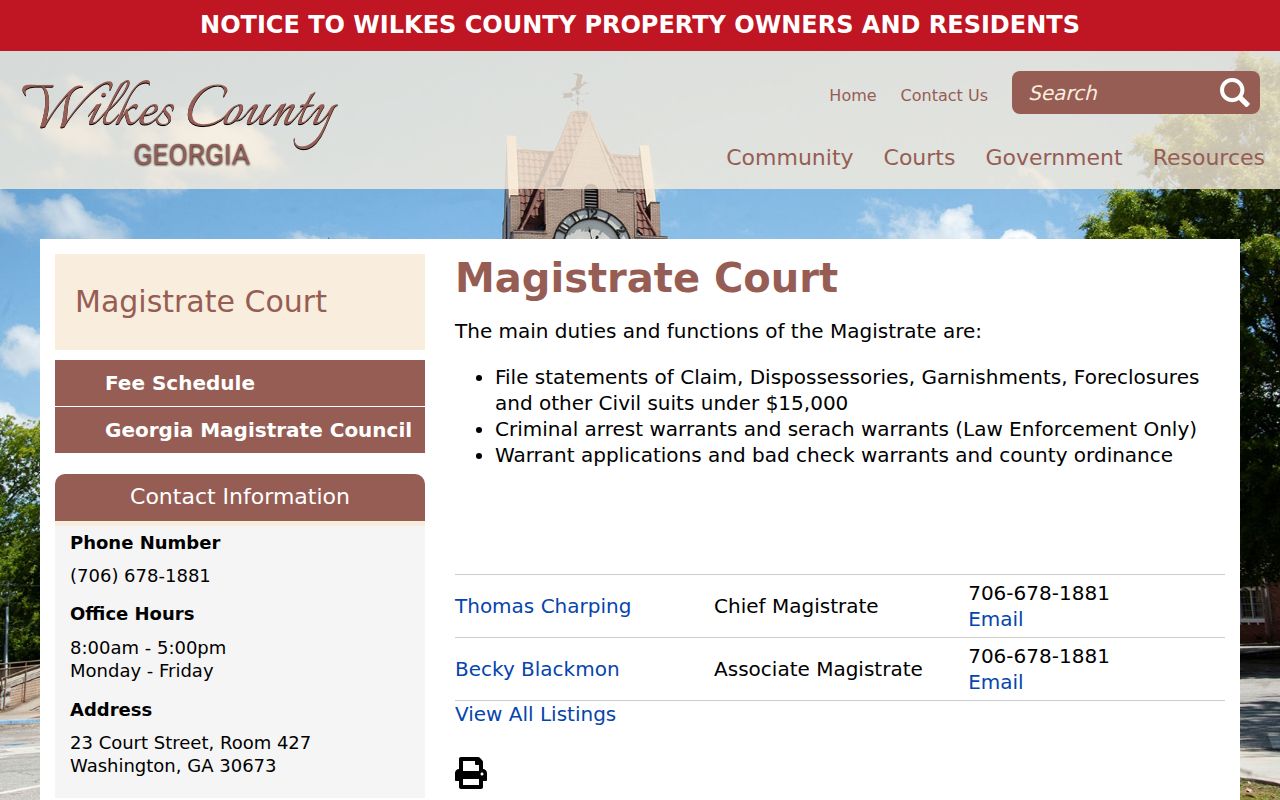
That qualifier limits access. It does not bar you from asking about your own Wilkes County status or requesting an existing public record. Call Magistrate Court at 706-678-1881. The office sits at 23 Court Street, Washington, and staff can point you to the issuing court if it does not hold the record.
How Wilkes County Arrest Warrants Are Served
The Sheriff's Office, or another authorized agency, executes a Wilkes County arrest warrant, which means taking the named person into custody and starting the required court process. The issuing judge still handles the judicial decisions. Service, booking, first appearance, bond, and later disposition are related events. They are not one status.
- A judicial officer issues the warrant on probable cause.
- The record is made available to authorized law enforcement.
- An officer executes the order under applicable law.
- The person is taken through first-appearance and bond procedures.
- The criminal case continues until a court disposition.
The Sheriff's official contact page publishes the agency's main, dispatch, investigations, and fax channels.
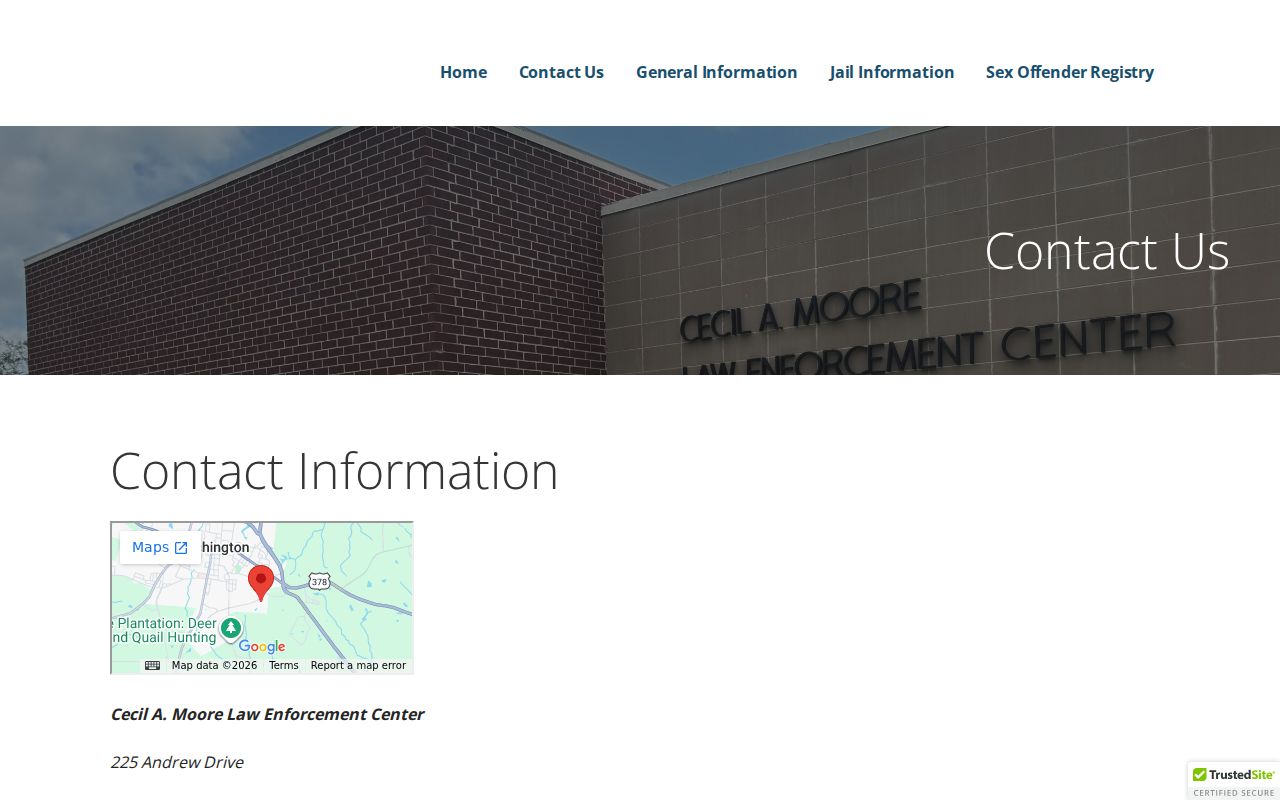
Start there for service status in Wilkes County. The calls do not replace the issuing court's record or advice from counsel.
Wilkes Arrest Warrant Court Roles
The Sheriff and the court answer different questions. Ask the Sheriff whether your own Wilkes County status can be checked by phone, whether identification is required, and which agency handles execution. Ask the issuing court about the warrant record, first appearance, bond, the calendar, and any later judicial order. The two systems may not sync at once. When the result matters, confirm with both.
Sheriff's Office
225 Andrew Drive, Washington
706-678-2224
Superior Court Clerk
23 Court Street, Room 301
706-678-2423
Magistrate Court
23 Court Street, Washington
706-678-1881
Not every warrant fits the Wilkes County routing above. Washington and Tignall municipal contacts keep their own city files, juvenile records carry special confidentiality rules, and federal process belongs to the Southern District of Georgia and federal agencies. Know which system holds yours.
Arrest Warrant vs Summons vs Bench Warrant
These papers look alike but command different acts. In a Wilkes County criminal matter, an arrest warrant permits apprehension based on probable cause. A summons orders an appearance without any arrest command. A bench warrant answers a missed court duty in a pending case. A search warrant targets a place, property, or evidence, and it is not a public person-name lookup.
| Document | Basis | Immediate Function |
|---|---|---|
| Arrest warrant | Probable cause of an offense | Authorizes apprehension |
| Summons | Formal court process | Directs appearance |
| Bench warrant | Missed date or unmet order | Returns person to court |
| Search warrant | Probable cause tied to evidence | Authorizes a defined search |
The Wilkes County Magistrate page keeps that law-enforcement-only rule. A general name request will not yield tactical details, affidavit targets, or evidence locations.
Wilkes Arrest Warrants After HB 1131
HB 1131 took effect July 1, 2026. It amended O.C.G.A. §§17-4-40, 17-4-41, and 17-6-15. The changes touch warrant-application notice, the information an accused person must receive, and several cash-bond and professional-surety provisions. That is the full scope. The law does not hand every Wilkes County warrant a single notice method. Nor did it rewrite existing warrants on its own. For the enacted text, the official signed HB 1131 is what controls. County and court pages can lag behind a new statute, so if you hold a specific Wilkes County warrant, ask the issuing court or an attorney how the current rules apply to that record. No Wilkes office has posted an implementation notice.
Current-law check: A 2026 statute change does not itself prove that any individual Wilkes County arrest warrant was recalled or excused.
What to Do If There's a Warrant for You
Get the facts straight first. Before calling anyone in Wilkes County, gather the full legal name, date of birth, the likely county or city, a case or incident number, and the issuing agency if you know it. Skip ordinary email for sensitive details. A lawyer can reach the court for you, walk you through surrender and bond options, and stand up for your rights along the way. The clerk, meanwhile, can explain how filing works but can't tell you which choice to make.
- Call the Sheriff and ask how a personal warrant inquiry is handled.
- Identify the issuing court and confirm the present judicial record.
- Consult counsel about surrender, first appearance, and bond.
- Follow the court's directions and keep every signed order or receipt.
- Verify later status with both the court and serving agency when needed.
Wilkes County sets no countywide bond amounts, and no office here publishes a bond schedule, a surety list, or an after-hours window. There is no recall form, amnesty day, or safe-surrender program either. The Magistrate fee schedule's civil filing charges and its $20 deposit-account-fraud-warrant line cover fees, not bond amounts.
Request Wilkes Arrest Warrant Records
The Georgia Open Records Act lets you ask any agency for a record that already exists and is identifiable, though exemptions and redactions apply. An agency should generally respond within three business days. When it cannot produce records that fast, it must state the estimated production date, the cost, and its legal basis. It does not have to build a new list, do research for you, or hand out protected operational information. Good requests name a thing that exists. Think an arrest-warrant record, a warrant application if public, a service return, a disposition, or a redacted record-series index for a defined date range. Municipal retention codes can sharpen the ask: JB-090 covers executed warrants and JB-091 covers open arrest warrants. Those labels help define a request, but they guarantee nothing and never answer whether a person has a current Wilkes County warrant. Where you send it matters too. The Clerk of Superior Court's judicial division handles criminal filing, storage, retrieval, calendars, and final dispositions, while the Sheriff holds the law-enforcement records in its custody. Ask either office to route the request if some other custodian keeps what you want. Sealed, juvenile, and active investigative records may be withheld or redacted under the law that applies. Keep it tight: state the court, the record type, and a narrow date range. Add a case number when you have one, and ask for electronic delivery. Do not demand that an agency create a roster or draw a legal conclusion. A records response shows what existed at one point in time. Your own status still needs a fresh answer from the issuing Wilkes County court and the agency responsible for service.